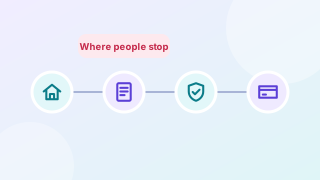
 Journey map
Registration Journey Map: Landing to First Deposit
Four stages from landing to first deposit, with the check for each.
Journey Mapping Studio
A journey map lays out what a player does at each stage, where they get stuck and what helps. Ours add the rules and WCAG checks that apply, so a product, UX or compliance team can review a casino or sportsbook flow from one page.
The matrix below covers seven stages, from the first page a player sees to managing their account months later. Each column gives the player's actions, the touchpoints, the friction to look for, a support moment, an accessibility note and a rule to check, with a link to the research behind it. Choose a stage to highlight it, use the arrow keys to move between stages, and download one stage or the whole matrix as a spreadsheet file.
Below the matrix are three detailed maps for the flows that matter most for player safety and trust: registration, withdrawal and safer play tools. Every map is a review template built from published rules and standards. None of them describes a real operator or reports measured results. See journey map and friction point in the glossary.
Rules shown are examples from Great Britain, Ontario and Australia; check each market.
| Player actions | Browse the site and read the offer | Enter details and agree to terms | Upload ID and wait for a decision | Choose a method and make a deposit | Explore games and set preferences | Request a withdrawal and track it | Update details and use safer play tools |
|---|---|---|---|---|---|---|---|
| Touchpoints | Home page, promotions page | Sign-up form, terms page | Document upload, status screen | Cashier, payment provider window | Lobby, game window | Cashier, email or app updates | Account menu, limits page |
| Friction to look for | Offer terms hidden behind a link | Long forms and vague error messages | No timeframe and repeated document requests | Fees, limits or processing times missing | Safer play tools hard to reach mid-session | No status updates or expected timing | Settings buried several menus deep |
| Support moments | Plain terms beside the offer and a safer play link | Step indicator and errors next to each field | Status updates and a clear next step | A limit prompt before the first deposit | Time played and net position in view | A receipt with amount, method and next update | Controls one step from the account menu |
| Accessibility notes | Text alternatives for banner images | A visible label and error text for every field | Accessible file upload with written instructions | A keyboard path through the cashier | Status shown with text, not color alone | Status changes announced to screen readers | Consistent menus and a logical focus order |
| Rules to check | AGCO 2.08: help information visible to all players | AGCO 2.23: limits offered at registration | GB: verify before gambling; AU: verify before a bet | GB: prompt to set a financial limit before first deposit | GB: slots show net position and time played | GB: reverse withdrawals banned since 2021 | AGCO 2.24: 24-hour wait before a limit is relaxed |
| Research | Navigation and Information Architecture for Casino Sites | Registration Friction in Casino Sign-Up Flows | Account Verification Without the Guesswork | Deposit Pages That Show the Whole Picture | Safer Play Tools People Can Actually Find | Withdrawal Clarity: Status, Timing and Trust | Dark Patterns and Player Autonomy |
Choose a stage to see its notes and download them.
Journey mapFour stages from landing to first deposit, with the check for each.
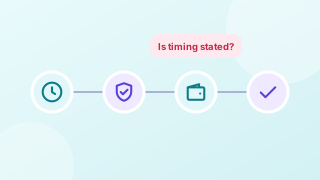 Journey map
Four stages from request to money received, with the check for each.
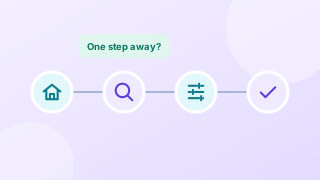 Journey map
Four stages from the account page to a confirmed limit.
The matrix gives one line per stage across the whole product. The detailed maps cover one flow with four stages and more columns, such as the player's goal and a fuller rule reference.
Yes. The stages are the same, with betting in place of gameplay. Add sportsbook-specific checks, such as how the bet slip behaves on a phone.
Every source was read on October 27, 2026. How we choose and date sources: data sources.
Send the editors a correction, a source or a research question. A person reads every message.